By Ken Spero
Anyone who has worked in schools knows this: leadership matters. The Wallace Foundation has spent two decades putting numbers, research, and clarity behind that simple truth. Their work has consistently shown that principals shape almost every aspect of school life—school climate, teacher satisfaction, student opportunity, and a school’s ability to hold steady under pressure.
I’ve had the opportunity to see this firsthand in our work alongside several Wallace Foundation initiatives. We have partnered with grantees from the Principal Pipeline Initiative, the Redesigning Principal Preparation (UPPI) Grant, and most recently the Equity-Centered Leadership work. These efforts are vital, and it has been an honor to collaborate with the districts, universities, and institutions engaged in this mission.
Yet even with all this progress, one question remains surprisingly hard to answer: How do we develop that kind of leadership in a way that is consistent, scalable, and responsive to the very different realities districts face?
The newest RAND/Wallace report, How Large and Small Districts Develop Their Principals (2025), brings important clarity to that question. It shows how districts actually prepare school leaders today and highlights where the biggest educator learning gaps remain. What struck me most is how clearly the findings point toward the need for practice-based learning—especially for assistant principals and for small districts that lack access to coaching and mentoring.
You can read the full report here: : How Large and Small Districts Develop Their Principals Selected Findings from the Spring 2025 American School District Panel Survey | Wallace Foundation
One quick note: in my analysis, I include rural districts within the broader category of small districts, as much has already been written about the additional staffing and development challenges rural systems face.
The good news is that our clients are already having success closing these gaps with scalable Simulations from SchoolSims
- What the RAND/Wallace Report Tells Us—And Why It Matters
The report offers a country-wide view of who becomes a principal and what kinds of professional development they receive. A few findings jump off the page:
- Large districts hire internally; small districts hire externally.Large districts draw most principals from the AP pool. Small districts rely more on outside hires or direct-from-teacher appointments.
- High-impact PD is scarce, especially for APs.Coaching and mentoring are limited almost everywhere—exactly the supports research says matter most.
- Small districts offer less PD overall.When they do offer it, it’s usually lighter-touch, and leaders have more autonomy in choosing it.
These patterns line up with what many of us see every day: huge variation in what leadership preparation looks like, depending on the size and structure of a district.
But the most important finding is the simplest:
districts want stronger pipelines—they just lack scalable, practice-based tools to build them.
And that’s where Sims come in.
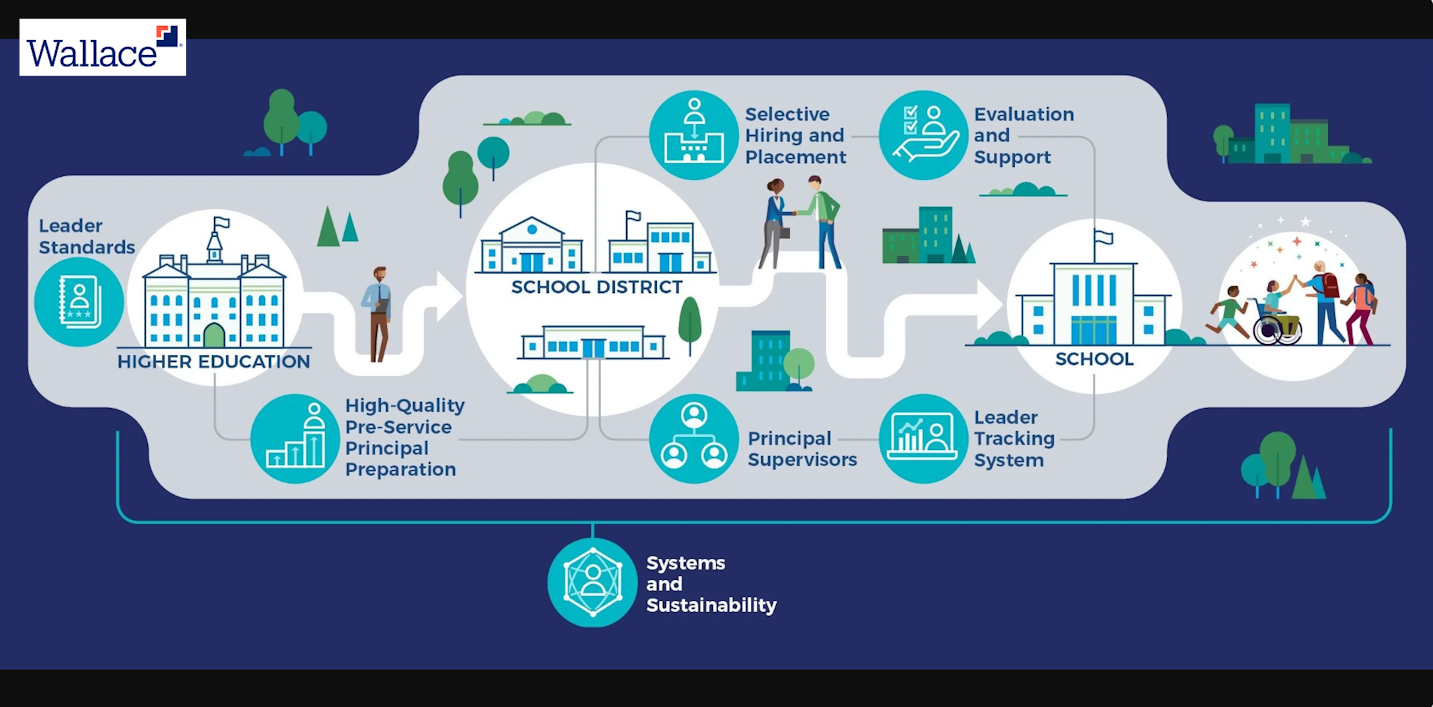
RAND/Wallace Principal Pipeline
- Starting Where the Need Is Greatest: Rural and Small Districts
I want to begin here deliberately. Rural and smaller districts often carry the heaviest lift when it comes to school leadership development—even though they usually operate with the fewest resources and the most geographic isolation.
2.1 The Reality on the Ground for Rural and Small Systems
If you talk with rural superintendents or principals, a set of familiar challenges surfaces quickly:
- Many schools don’t have assistant principals at all.
- Principals are promoted directly from teaching and often step into the role “cold.”
- Access to coaching and mentoring is minimal.
- Travel distances make shared PD difficult.
- Central office teams are lean.
- Principals can feel professionally alone.
The RAND/Wallace report confirms these realities. Small school districts offered far less PD than larger ones, especially for APs—largely because the AP role is less common in rural settings.
In other words: the need is high, and the access is low.
That’s precisely where Sims deliver outsized value.
2.2 High-Quality Leadership Practice Without Needing Big Infrastructure
Small districts don’t have leadership academies, multiple supervisors, or mentoring benches. Sims allow rural leaders to engage in high-quality, standards-aligned, practice-based PD without needing any of that infrastructure.
Leaders can log in, engage in a real-world dilemma aligned to their state or national standards, reflect on their reasoning, and walk away better prepared than they were an hour earlier.
It’s simple, it’s accessible, and it’s scalable.
2.3 Helping Principals Build and Align Their Teams
One of the most overlooked strengths of simulations is how well they work as team learning tools.
Rural principals, in particular, rely heavily on their leadership teams—teacher-leaders, counselors, coaches—because central office capacity is thin. Sims give these teams:
- A safe way to discuss hard issues.
- A shared experience they can unpack together.
- A way to surface assumptions and decision habits.
- A chance to align around how the school will address conflict, equity, communication, or community pressure.
Because Sims are fictionalized, teams can dive into deep issues without the defensiveness that sometimes arises when discussing real school incidents.
2.4 Overcoming Geography: Scalable PD Across Distance
One of the biggest barriers for rural districts is geography. Leaders may be separated by 50 miles or more. Sims cut straight through that barrier:
- Teams can complete them asynchronously.
- Regional cohorts can run them together virtually.
- County offices can use them to unify multi-district leadership groups.
This kind of alignment is incredibly hard to achieve in rural systems—but simulations make it possible.
2.5 Strengthening the Teacher-to-Principal Pathway
Because many rural principals come directly from teaching, Sims give aspiring leaders a way to “try on the role” and build judgment before stepping into it. This reduces the shock of entry, increases confidence, and can help stabilize early-career principals who might otherwise feel overwhelmed.
- Large Districts: Where Sims Strengthen and Extend Principal Pipelines
Large districts have a different challenge. They usually have the structures—AP pools, induction, leadership academies—but they still struggle to deliver practice-based, high-impact development at scale.
The RAND/Wallace findings make that clear: even in large systems, the most effective supports (coaching, mentoring) are limited, especially for APs.
Sims fill that gap without replacing existing structures.
3.1 Giving Every Pipeline Cohort Practice Opportunities
Large districts often organize their pipeline into:
- Aspiring leaders
- Assistant principals
- Novice principals
Sims can anchor each stage with increasingly complex scenarios. Everyone builds experience with the same core dilemmas—equity, culture, communication, conflict—creating coherence across the entire pipeline.
3.2 The AP Gap: The Most Underserved Group
The report shows a striking pattern: APs receive the least coaching and mentoring, even though they are the primary pool for future principals in large districts.
Sims give APs a safe place to practice principal-level decisions, reflect, and grow. It’s one of the most effective—and overlooked—ways to strengthen the quality of future principals.
3.3 A Tool for Principal Supervisors
Wallace’s Who Has the Principal’s Back? argues that principal supervisors are essential and often underestimated. They are the bridge between central office expectations and principal support.
Sims give supervisors a concrete way to coach:
- “Walk me through why you chose that option.”
- “How would this play out in your building?”
- “Let’s connect this to your goals and evidence.”
It moves supervision from evaluation to development—exactly what Wallace calls for.
3.4 System Alignment Across Large, Complex Organizations
With large districts, the challenge is often coherence. Principals in different regions or networks may receive very different messages.
Sims create a shared set of leadership experiences that everyone can reference. That consistency strengthens culture, reinforces equity commitments, and supports more aligned decision-making.
3.5 Data for Coaching and Succession Planning
Simulations generate actionable insights:
- decision paths
- reflection quality
- handling of conflict
- tendencies under stress
This kind of data is helpful for:
- identifying emerging leaders
- directing coaching
- targeting districtwide PD
- supporting succession decisions
It is not evaluative—it’s developmental.
And it pairs well with Wallace’s push for richer, practice-based measures of leadership.
- Why Simulations Work: Adult Learning, Self-Efficacy, and Resilience
One of the things I emphasize often is that Sims are not just engaging—they are grounded in how adults actually learn.
4.1 Adult Learning Principles
Adults learn best when:
- content feels relevant
- they can make decisions
- they see consequences
- they reflect on what happened
Sims check every box. They turn PD from a passive experience into something real, challenging, and meaningful.
4.2 Building Self-Efficacy
There’s a growing body of research showing that simulation-based learning increases self-efficacy. Leaders who practice in a safe environment:
- become more confident,
- less reactive,
- more consistent, and
- more willing to take on tough challenges.
This matters because leaders with higher self-efficacy are far more likely to stay in their roles longer, which improves stability, culture, and climate.
4.3 Strengthening Resilience
Modern school leadership demands resilience. Sims help leaders build it by exposing them to complex, emotionally charged scenarios in a controlled environment. They learn:
- to think clearly under stress
- to navigate conflict productively
- to manage uncertainty
- to reflect before reacting
Resilience and self-efficacy together support longer tenures and healthier school climates—both major contributors to student success.
- A Path Forward: Studying Sims’ Impact on Retention and Climate
The RAND/Wallace report raises a future research opportunity:
How might a Sims-centered approach improve principal stability and school climate?
It’s not hard to imagine the chain:
Better practice → stronger skills → higher confidence → lower burnout → longer tenure → more stable climate → better outcomes for kids.
This aligns with Wallace’s shift toward measuring leadership not just by test scores, but by climate, culture, opportunity-to-learn indicators, and instructional conditions.
Sims generate exactly the kind of practice-based data that can feed these new measurement approaches.
- Final Thoughts
Across all of Wallace’s leadership work—PPI, UPPI, Equity-Centered Leadership, and now the RAND report—one message is consistent:
Leadership must be developed through practice, not position.
Simulations bring that principle to life.
For rural and small districts, Sims make high-quality leadership preparation possible in places where it has been historically out of reach.
For large districts, Sims give pipelines the practice element they often lack and provide principal supervisors with actionable tools.
And across every district size, Sims build the confidence, resilience, and alignment that leaders need to create climates where teachers can thrive and students can succeed.
That’s why they matter—and why they fit so naturally alongside the Wallace Foundation’s body of research.

Complete the form below to join our next webinar or receive the recording for the webinar related to this blog.